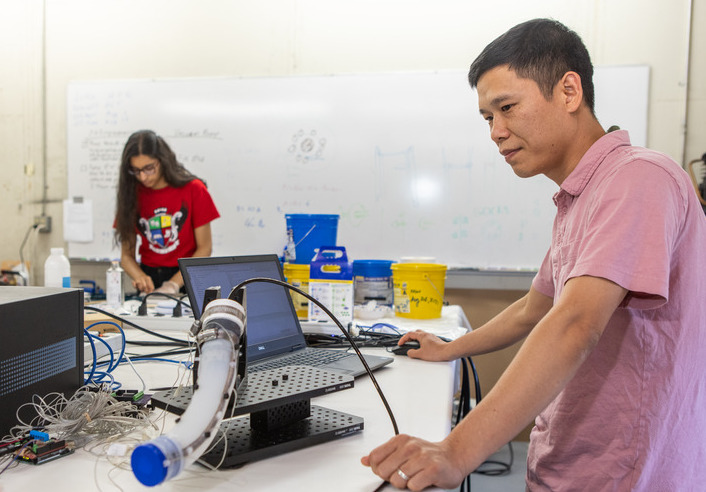
Gulnur Ualiyea, a doctoral student at the McDougall School of Petroleum Engineering, is pushing the boundaries for women in petroleum engineering with her groundbreaking research on downward gas-liquid flow. Originally from Kazakhstan, Gulnur brought her eight years of industry experience in pipeline oil transportation to The University of Tulsa’s North Campus Mesoscale Research Facility. Now, she is applying her expertise to explore a relatively under-researched area: the behavior of gas-liquid flow in downward directions.
While the study of gas-liquid flow is a well-established field in engineering, downward flow has not received the same attention. This gap in knowledge, according to Gulnur, represents a significant opportunity for advancement in the understanding of multiphase flow, which is crucial for improving carbon dioxide (CO2) well injection design — a process that plays a key role in the storage and sequestration of carbon dioxide.
Gulnur’s groundbreaking work utilizes a combination of cutting-edge instrumentation, a unique research facility, and advanced computer vision techniques to capture the dynamics of gas-liquid flow in unprecedented detail. This innovative approach allows her to observe the flow behaviors with much higher precision than traditional methods, shedding new light on the complex interactions between gas and liquid phases.
The potential applications of Gulnur’s research extend far beyond the confines of her dissertation. By enhancing the accuracy of existing mechanistic models used in CO2 well injection design, her work could lead to more efficient and safer carbon capture and storage (CCS) techniques — a critical technology in the global fight against climate change. Effective CO2 injection models are essential for ensuring that injected gases remain safely contained underground without leakage, a challenge that has become even more pressing with the increasing demand for large-scale CCS projects.
Gulnur’s pioneering research has garnered significant recognition in the global scientific community. She has presented her findings at several of the most prestigious conferences in multiphase flow transport, where her work has been met with enthusiasm and praise from leading experts in the field. Her contributions have also been notable in advancing the role of women in the traditionally male-dominated petroleum engineering industry. Gulnur is not only contributing to the technical knowledge in her field but is also serving as an inspiration for future generations of female engineers.

The McDougall School of Petroleum Engineering is proud of Gulnur’s achievements and her commitment to advancing both the science of petroleum engineering and the role of women in the profession. “Gulnur’s research represents the kind of innovation that will drive the future of our industry,” said Eduardo Pereyra, the F.F. “Mick” Merelli/Coterra Energy Chair Professor in Petroleum Engineering. “Her work has the potential to make a profound impact on how we approach CO2 injection and climate change mitigation.”
As Gulnur moves forward in her Ph.D. journey, her passion for exploration and innovation continues to fuel her research. With her impressive combination of academic rigor and real-world experience, Gulnur is poised to make lasting contributions to the field of petroleum engineering and the broader goal of sustainable energy solutions.
“Experimental results have revealed unexpected and important phenomena in downward two-phase flow. Accurately interpreting these findings is essential to improving the accuracy and reliability of existing models. It’s exciting to think that my work could contribute to addressing one of the most pressing challenges facing our planet today,” said Gulnur. “That said, I want to emphasize that this is a team effort—made possible by the collaboration of well-versed project engineer Scott Graham, skilled technicians Jose Aramburu, Luis Sanchez, and Lupe Trejo, and brilliant professors Dr. Cem Sarica and Dr. Eduardo Pereyra.”