Imagine getting a team together to prototype, build, then shoot a rocket successfully at an advanced international competition within less than a year. A group of University of Tulsa engineering students did just that.
The University of Tulsa’s Hurricane Rocketry Club placed in the top 20 out of 96 teams in their division at the International Rocketry Engineering Competition in Midland, Texas — a remarkable achievement for a club that didn’t exist a year ago.
The seven-member team, composed of seven engineering and computer science students, was the only Oklahoma team to compete at IREC, the world’s largest university rocket engineering competition. This year’s event drew 172 universities, including international teams from South Korea, India, and Australia.
“Last summer, I was a math tutor and there was a student here who would make 3D printed rockets. I thought, ‘why am I not doing this?’” said second year mechanical engineering student Ryan Smith.
He reached out to department professors John Henshaw and Will LePage, who helped him in securing funding. Smith also reached out to local non-profit Tulsa Rocketry. The president, Paul Reid, mentored the team in their early steps. in their early steps.
The Hurricane Rocketry Club secured $15,000 from various university sources: the College of Engineering and Computer Science, the departments of mechanical engineering and electrical and computer engineering, the Office of Research & Economic Development, and JOLT.
Local partners — manufacturer Webco, Tulsa Rocketry, aerospace manufacturing Orizon, and Neidecker Farms — provided additional funding.
Tulsa Rocketry and UTulsa graduate student Michael Lester (B.S. ’23, M.S. ’25) helped the team secure high-power rocketry certifications, a requirement to attend competitions.
IREC recommends that teams have multiple years of rocketry experience, but Smith still made it a goal to be invited to the competition.
Working with Professor of Electrical and Computer Engineering Peter LoPresti, the team developed a payload to advance free space optical communication — technology that transmits high-speed data through focused infrared beams.
Through that process, they developed a payload to assist in the advancement of free space optical communication, technology that supports high-speed data transmission through focused infrared light beams.
By the end of the academic year, the team had successfully built their rocket for the competition. However, that was only one part of attending IREC. The competition was not going to be easy. The team had to prepare to fly in a remote desert.
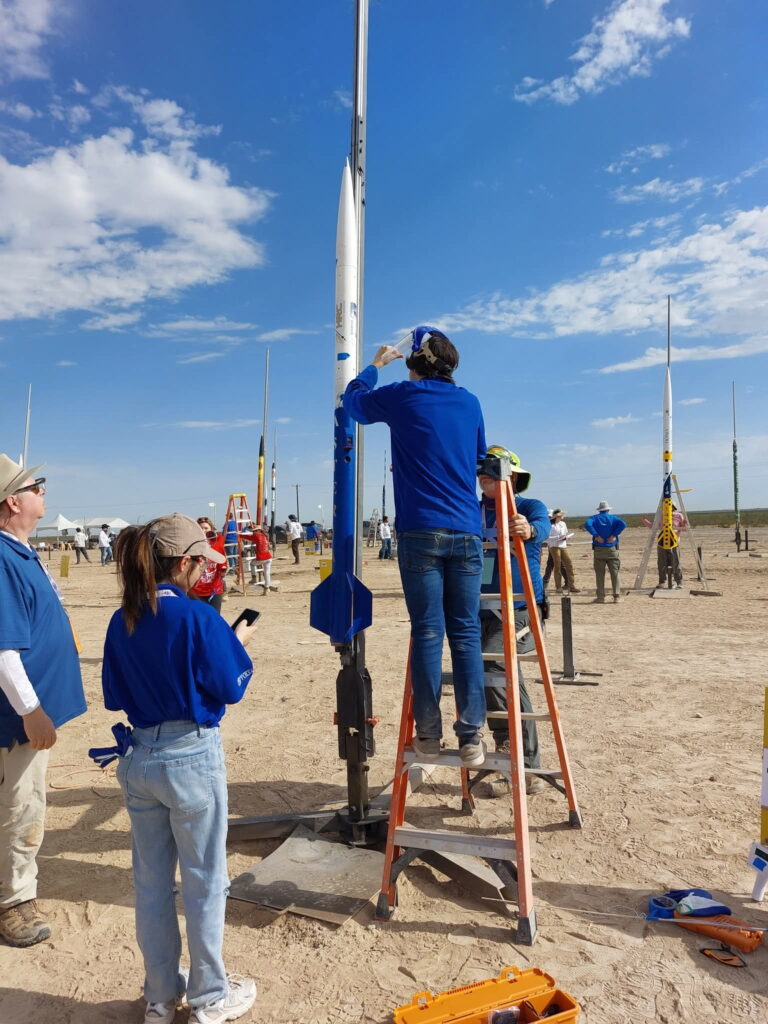
“There were multiple days of competition. We had a long window to fly, but due to a dust storm, we did not get to launch until the second day,” said Smith. “We were in the middle of the Chihuahuan desert. The temperature can get well over 100 degrees Fahrenheit every day. But we were launching that rocket no matter what.”
After the dust storm, the team launched their rocket in the afternoon. They then had to track and recover it to be scored. Despite having two onboard GPS units, technical difficulties made the search take all day.
“To be scored successfully at IREC, you have to recover the rocket and show that there’s minimal damage, and it can be launched again,” Smith explained. “Some teams weren’t even able to recover their rockets.”

The team found their rocket at sunset with virtually no damage. Competition judges awarded them full points for recovery the next morning. Their rocket reached 9,815 feet — 185 feet short of their 10,000-foot target.
The team’s simulated versus actual altitude resulted in a percent error of 0.38%, earning them second place in the James Barrowman Award for Flight Dynamics.
Beyond technical achievements, the experience strengthened team bonds and developed project management and problem-solving skills.
“The little things brought us together,” said Smith. “Leaving that competition, we learned so much about each other. We are all closer because of it.”
The team plans to compete again this upcoming academic year.
The Hurricane Rocketry Club offers UTulsa students hands-on experience with large-scale engineering projects requiring design, integration and teamwork — opportunities that allow students to pursue research, compete at high levels and build lasting relationships.