At The University of Tulsa, students and faculty from around the world come together to pursue academic and professional excellence. One such scholar is Gustavo Carvalho, a petroleum engineering doctoral student from Rio de Janeiro. Drawn by the College of Engineering & Computer Science’s historic legacy in petroleum research, Carvalho embraced the opportunity to move to Tulsa.
“As an international doctoral student, I have had contact with people from different parts of the world,” he explained. “This exposure fosters an environment conducive to the generation of new ideas and the expansion of the boundaries of the knowledge – an essential aspect of a doctoral degree.”
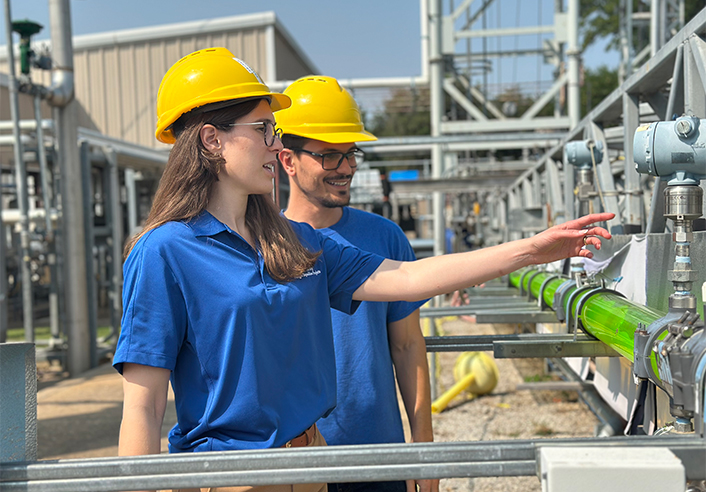
At UTulsa’s North Campus, Carvalho has developed his expertise on understanding multiphase flow, an occurrence when oil, gas and water flow through equipment or pipelines. His research studies heat transfer in the flow, using controlled experiments and developing mathematical models to improve artificial lift solutions.
“One widely used solution is the electrical submersible pump (ESP), which relies on a motor often damaged by the high temperatures presented in the wellbore,” he explained. “My research investigates how the multiphase flow around the ESP motor affects heat dissipation. We want to see how to condition the equipment to operate efficiently without suffering damage caused by the temperature increase.”

Carvalho collaborates on this research with Research Assistant Professor Carina Nogueira Sondermann, D.Sc., who is also from Brazil. They study slug flow, an inherently transient flow pattern that may occur when gas and liquid meet in a pipe. This plays an important role in determining the temperature of the ESP motor.
Sondermann’s research focuses on experimental studies, modeling and numerical simulations on multiphase flow. She works in collaboration with the Tulsa University Fluid Flow Projects and the Tulsa University Horizontal Well and Artificial Lift Projects.
“I not only aim to conduct my own research and projects but also give the students tools and support so they can lead their research the best way possible,” she explained. “It is important to connect the pieces of research from each student as a bigger contribution to the field, which is to have a better prediction and understanding of multiphase flow in pipes.”
The team’s work has attracted attention from several local and international energy companies. “We try always to develop new models, new tools, so they can easily apply it in their applications. That keeps us continuously involved with the industry’s needs,” she said.
“Carvalho and Sondermann are the best examples of the UTulsa tradition in the oil and gas industry,” said Eduardo Pereyra, F.H. “Mick” Merelli / Coterra Energy Chair Professor of Petroleum Engineering. “They are expanding human knowledge and translating it into practical applications to support the evolution of the oil and gas industry.
“They are also looking to provide solutions for a complex multi-phase problem that can allow the exploitation of new reservoirs. This gives their results an international reach, opening new opportunities not only for our industry but also for the university.”
This North Campus research not only contributes to academic knowledge but also to practical solutions for industry challenges, reinforcing UTulsa’s role as a leader in petroleum innovation.