Faculty in The University of Tulsa’s Department of Mathematics are creating hands-on research opportunities for undergraduate students through a unique initiative.
Professor Richard Redner, Ph.D., and Assistant Professor Nicholas Cox-Steib, Ph.D., have created a research initiative centered on zero-one matrices – binary matrices that while widely applicable in fields such as signal processing, computer science, and graph theory are also being explored for their vastness beyond those applications for the Tulsa Undergraduate Research Challenge (TURC). Both faculty members have received TURC mentoring allocations, supporting their academic work.
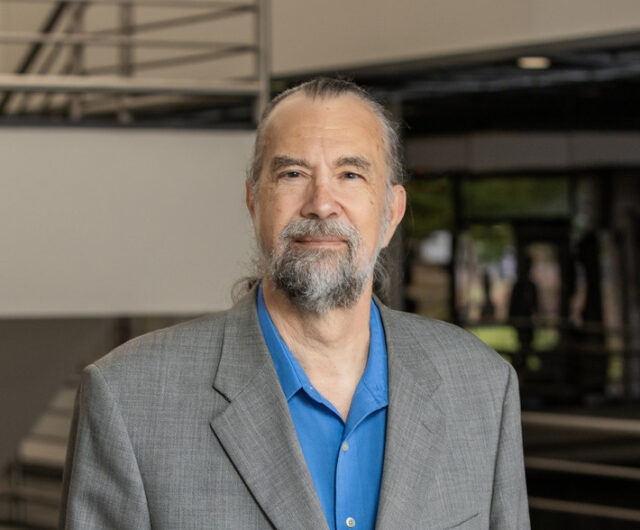
“Our motivation for studying zero-one matrices isn’t tied to a specific application,” Redner explained. “We find these problems are abundant, interesting and accessible to undergraduates at all levels.”
This initiative grew out of collaborative work between Redner and Cox-Steib on the Han-Monsky Representation Ring, a complex area of algebraic structures. Their joint research is now ready for journal submission, and the extension into zero-one matrices has opened the door for undergraduate involvement.
During the past two years, more than a dozen students have joined the research group. The group’s work touches on mathematical questions dating back more than a century, including those posed by French mathematician Jacques Hadamard in 1893. While some students discovered the project through TURC, many students were drawn simply by curiosity and a love for mathematics
Redner and Cox-Steib bring personal experiences into this program. Redner’s interest stems from his undergraduate studies at Guilford College, which led to his first publication in the Journal of Undergraduate Mathematics.
Cox-Steib (B.S. ’15) collaborated with Professor Kevin O’Neil, Ph.D., during his undergraduate studies at UTulsa on a project that produced the publication “Generalized Adler-Moser and Loutsenko Polynomials for Point Vortex Equilibria” in Regular & Chaotic Dynamics.
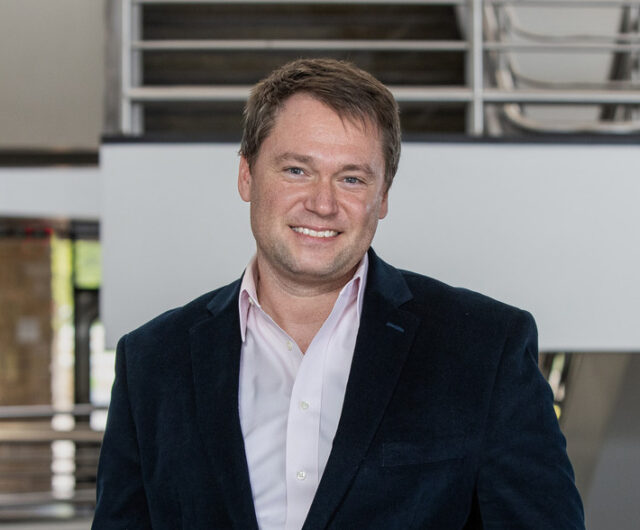
“My interest in undergraduate research opportunities started here,” Cox-Steib said. “Working with our bright undergraduates is one of my highlights teaching here now.”
“This program not only enriches the academic experience of our students but also strengthens the department’s mission to foster curiosity, collaboration and discovery,” Redner added.
“Many students come to college knowing they enjoy math but don’t know what research in mathematics could mean,” said Amy Schachle, a faculty member and interim chair of the department. “Research experiences for undergraduates can open the door to a whole new world of mathematics and what mathematicians do. Opportunities like this can inspire students to pursue graduate studies in mathematics, as this has been the case for some of the alumni from the zero-one matrices project.”